The Power of Follow Ups
One of the best ways to create synergy and boost your marketing reach via your partnerships is to share content. Cross posting and guest posting on your clients’ or partners’ blogs and social media platforms increases your reach, generates additional trust and loyalty for your business, and opens doors to more interesting and relevant content.
For example, this month we’re sharing an infographic and guest post about Sales Skills from IRC that talks about the power of following up with your prospects. Check out the article, written by Nicholas Rubright, and the infographic:
The importance of following up with sales prospects is undeniable. Research shows that 80% of sales happen after the fifth interaction. Despite the fact that this approach has proven effective time and again for closing deals, only 44% of salespeople actually make more than one attempt to close a sale.
A key takeaway from this data is that consistency and perseverance are the backbones of any sales strategy. Your ROI will always seem low when you give up too soon, or never try at all!
Research indicates that 40% of your prospects will be at the beginning stages of their buying process, which means they won’t have a clear idea of what product will best suit them. That being said, you can make sales by continuing to show up while the competition has given up.
To ensure maximum success in your sales and marketing strategies, follow the tips provided by this infographic. And be sure to remember this: success in sales isn’t creating the perfect circumstances to close, it’s about being confident and prepared enough to make a sale whenever your prospect is ready.

The Complete Guide to Cause Marketing
“Cause marketing” is rapidly becoming one of the smartest decisions you can make for your business as more and more people are making ethics-based decisions, choosing to work with cause-conscious companies as a priority. Perhaps the most recognizable cause marketing campaign is Subaru’s “Share the Love” initiative, in which every car sale includes a donation to a charity.
This practice of partnering with charities and non-profit organizations, or taking a social responsibility stance, generates brand trust, goodwill, and loyalty that reflects positively on your company but also enhances your position in the B2C and B2B marketplaces. Check out Brandwatch‘s cause marketing guide to see how these strategies can help YOUR business.

Website Accessibility & the Law: Why Your Website Must Be Compliant
The Americans With Disabilities Act (ADA) of 1990 wrote into law the right of all persons to have access to public facilities, spaces, and resources regardless of visible or invisible disability. While this legislation has been very helpful in increasing physical accessibility through initiatives like ramp-building, TTY programs, designated parking areas, and more – the ADA was drafted before the internet became a mainstay of daily life, and does not provide clear guidance on how to adapt accessibility to the digital and virtual realms. Because general accessibility liabilities apply equally to your business’ physical store or office location and to your company website, it’s important to understand how the ADA applies to your digital presence. Learn more about accessibility law and how to be in compliance in this article.
Read the full article at: www.searchenginejournal.com

What is Digital Accessibility?
You’re probably familiar with the concept of accessibility – adding wheelchair ramps, reserving disability-friendly parking, including Braille on signage, providing automatic doors, and many other initiatives and adaptations that allow equal access to stores, facilities, and resources. The Americans with Disabilities Act (ADA) has enforced the right of all people to have equal opportunity regardless of ability status. This legislation has made sweeping improvements in physical accessibility, but did you realize that the ADA applies to the digital world as well?
Website accessibility is often overlooked, in part because the ADA legislation was drafted in 1990 – before the internet boom created a new set of virtual and digital accessibility issues. From a legal perspective, the gray area in the ADA regarding internet accessibility isn’t an excuse to forego the same standards on a company website or application. And of course, you could be missing out on customers if your website isn’t adaptable to different needs and accommodations – that’s about 25% of the population, according to the Centers for Disease Control!
Consider some of these situations:
- Can someone with a visual impairment still learn about your business from your website, or is all of your content directed at someone who can read your words and see your images? For instance, does your site design incorporate high contrast and legible font size?
- Can someone with limited physical mobility interact with your website? Is your site navigable without the ability to use a keyboard? Is it navigable without the use of a mouse?
- Can a screen reader access your site to properly translate it as needed? Are your pages dependent on a style sheet that might confuse a screen reader? Do you use an HTML table that cannot be parsed properly by a screen reader? Do your images have alt-text screen readers use to speak text aloud?
- Do your videos or other content negatively affect groups of users? Are there flashing elements on your site that might cause seizures? Are you using a color scheme that may be difficult to parse with color blindness?
If you’re not sure about any of these questions, you’re not alone – many businesses aren’t well acquainted with website accessibility yet. It also used to be much more expensive and difficult to implement accessibility features, often requiring highly specialized (and high-cost) consultancies to create a program, and though the ADA laws apply equally to all companies, many small businesses simply couldn’t afford the price tag.
Unfortunately, a lack of understanding or a smaller budget have not been shield enough against legal action, and the number of ADA claims are on the rise. The Wall Street Journal reported a 23% increase in web, app, and video accessibility lawsuits from 2019 to 2020, possibly linked to COVID shutdowns forcing greater scrutiny of virtual and digital accessibility for work-related purposes.

The first step towards making your digital content more accessible and meeting compliance guidelines is learning about web accessibility and how to apply it to your company’s sites, applications, and content. We recommend checking USAbility.gov’s Accessibility Basics for a quick snapshot of website accessibility. If you’re looking for a deeper dive, deque’s Beginner’s Guide to Web Accessibility offers a more robust set of discussions about different facets of accessibility.
Additionally, we at Sales Renewal offer accessibility packages to bring your business’ website into compliance, then continue to monitor and fix any issues that arise as your site evolves over time. If you’re interested in seeing how an accessibility solution can help ALL of your website visitors, not just the ones with disabilities, try clicking the universal accessibility icon at the bottom right part of your screen, available on any Sales Renewal webpage!
Let us know how we can bring accessibility to your business. Contact us today!

The $242 Billion Business Of Corporate Gifting Pivoted From A Routine To A Priority In The Pandemic
Somewhere between the gratitude of Thanksgiving and the gift-giving of December traditions lies the industry of corporate gifting. Companies can deepen connections, build loyalty, and increase a sense of mutual value with both clients and employees through thoughtful, intentional tokens of appreciation. Here’s an inside look at this rapidly growing business as we head into the business gift giving season.
Read the full article at: www.forbes.com

5 Tips for Effective Marketing Communication
When building your business, having a great product or service is just the beginning. Communicating your company’s offerings, solutions, and advantages is crucial for turning a good product into a wildly successful one. But in the age of digital communication, traditional advertising is no longer the only way to tell people about what you offer. Connecting with your target audience through digital media can be an incredibly powerful asset to your brand and business – as long as you can optimize your message and create effective, ongoing communications with your customers.
Here are our top five tips to more effective marketing communication.
1. Articulate your marketing goal(s) and message
It’s difficult to be effective if you’re unsure what your goals are. Without defining a clear message and a way to measure the success of your communications, you’ll end up with a less cohesive and less engaging strategy that uses up time and resources without generating returns. Instead, practice making SMART goals that center around a clear, direct message.
2. Define and understand your audience
Knowing what you want to say is one thing, but knowing what your ideal customer wants to hear is another! Research your audience and identify what types of conversations or solutions are important to them. Learn where they go to find information that helps them make decisions. Craft your messages around your researched data to ensure you’re investing your marketing time and budget into communications that will get attention, rather than falling flat amid the rest of the market noise.
3. Tell a story
If the movie and television industry gives any indication, people love a great story – especially when they can identify with the characters and conflicts. Craft your messaging into relatable narratives that put your ideal customer at the center of the story. Creating recognizable situations and offering the best-fit solution to a known problem will help your brand establish a more intimate connection with your audience than traditional advertising.
4. Focus your message
Keep your eyes – and your communications – on the prize. Once you’ve identified a key concept and message, stick to it. Creating too many individual messages can become overwhelming to the consumer. If you have multiple messages that you’d like to work with, consider separating them into independent campaigns that build consistency around each message, rather than trying to work multiple discussions or points into the same campaign strategy.
5. Create a dialogue
One of the biggest advantages of digital marketing over older methods of advertising is the ability to have a conversation with your audience. A billboard or TV commercial is a one-way communication, but social media platforms, email marketing, and other digital media forms allow the customers to engage with the material and messaging. Open your campaign to dialogue by asking your audience questions, encouraging them to share their experiences with your brand, or by creating an approachable persona on your accounts. When your customers feel connected to your brand on a personal level, they are more likely to not only listen to what you have to say, but to act on your offerings as long-term clients.

The Power of Empathic Storytelling: How to Make Your Customer the Hero of Your Story
Modern consumers have evolved beyond the scope of traditional “buy this product” advertising; these days, your customers and clients are as interested in the why and how of products and services as they are in the what. Creating purposeful narratives that connect with your target audiences on a deeper personal or emotional level will help you stand out amongst your competitors and build a lasting bond that keeps your clients coming back. Discover how to focus your storytelling content on your customer in this article from Entrepreneur.
Read the full article at: www.entrepreneur.com

Six Ways Going “Green” Can Boost Your Bottom Line
We’ve heard it over and over again: it’s important for the environment to work “green” or eco-friendly initiatives into our lives whenever we can. For individuals, the path to a greener lifestyle is simpler, but for businesses, an eco-conscious approach may seem difficult to integrate at first. We think there are plenty of green initiatives your small business can adopt – and they’ll also be great for your bottom, and sometimes top, lines.
1. Grow your business by marketing your eco-friendly products, services and expertise
In every industry, there’s a largely untapped segment of buyers that values and is willing to pay for green products, services and expertise. Metro Sign & Awning (a Sales Renewal JointSourcing client), for example, wanted to cultivate new Partners who’d recommend their signage products and services in the Partners’ new construction projects. With our help, Metro created a series of white papers that helped Architects and Property Developers become more knowledgeable about green signage. The idea was that by making these prospective partners more knowledgeable about something Metro was expert at (eco-friendly signage), the partners would come off as more knowledgeable in front of their customers. This brought more business back to Metro as well, creating a clever – and successful – marketing campaign that not only built their own business, but also enhanced their partnerships while doing double duty for sustainability.
2. Share the knowledge.
Do your products and services have a long-term environmental impact? Let your customers know how working with you can impact THEIR green initiatives and bottom line! Outline both the financial and ecological ROI on a sustainable product. Generate content that discusses how your eco-friendly products can reduce your customers’ carbon footprint or eliminate their waste over time. By leveraging your own environmental consciousness into a marketing campaign, you’ll encourage your customers to invest in your products and services, while also doing double duty for sustainability! You can also grow your partners’ businesses by sharing your own green expertise, helping your partners win more customers through the wisdom you’ve passed to them.
3. Think outside the (recycling) box.
Green initiatives at your company aren’t limited to benefitting ONLY your company. Get creative with your business’ approach to environmental friendly decision making. Understand your carbon footprint and consider participating in carbon offset programs to supplement and enhance any company policies you have already implemented. Use your business voice to align with policy initiatives that align with your company’s values. Customers in the modern era are heavily attracted to purpose-driven businesses that publicly share – and take action on – their values. You’ll not only be doing the earth a favor, but you’ll be gaining favor with and growing your customer base!
4. Assess your energy needs.
Are you leaving equipment or lighting on overnight? Are you heating a conference room you only use once per week? Minimizing wasted energy sources will not only help the environment, but will also put a nice dent into your energy bills. Switch to LED lighting in place of incandescent bulbs, and put your lights on motion sensors to ensure lights are turned off when not in use. Set computers and other office equipment to hibernate or switch into sleep mode during periods of inactivity. Consider switching to laptops, which are more energy-efficient than desktops, whenever possible. You may also be eligible for rebates on your energy costs if you’re upgrading to eco-friendly equipment, so contact your energy supplier to see what incentives they may offer!
5. Assess your physical office needs.
Your business’ office footprint is your own piece of the environment, and needs as much care and consideration as the great outdoors. Find an office that is the right size for your needs to prevent wasted energy from heating and lighting spaces that are unused. When upgrading equipment or furnishing your office or workspaces, shop secondhand when possible (something Covid has made a lot easier with all the office downsizing going on now). Look for energy efficient machinery, or for sustainably built furniture that will outlast other construction. Or, consider eliminating your rent bill completely by allowing your employees to work remotely! Remote offices reduce pollution from commuting to and from the office, and reduce your employees’ gas and wear & tear expenses, so it’s a win all around!
6. Assess your paper needs.
Printing and paper use is a prime target for small businesses to make an impact with a few simple changes. Printing on both sides of each sheet will cut both your paper waste and your paper cost in half instantly. Or, use the back side of printed papers as scratch paper for note taking instead of purchasing sticky notes or other notepads. Or, consider going paperless completely! With the proliferation of cloud computing, records storage and document sharing can be done without a single sheet of paper; marketing can be managed online through email campaigns, social media, and websites; even sales and accounting can be migrated to online payment programs and bookkeeping software. Never buy another ream, nor another clunky printer or copier, again!

Benefits of Gender Diversity
With International Women’s Day happening this month, you may have seen your news feeds filled with appreciation, support, and celebration of women everywhere. Though that hasn’t always been the case for women in the workplace, the gender gap is rapidly closing – and the economic benefits of gender diversity has become readily apparent. Study after study has proven that the inclusion of women in business environments has direct and indirect financial benefits. In the US alone, gender equality practices and policies could inject over $4 trillion into the economy in the next five years, with gender-diverse businesses in some sectors showing up to 14% higher average revenue and up to 19% higher average quarterly net profit than less-diverse counterparts.
Why does gender diversity return such large economic benefits? One reason is that prioritizing gender diversity within the workplace allows businesses to draw from a much wider talent pool. With women typically obtaining college degrees at a higher rate than their male counterparts, this opens the door to more hiring options with a wider variety of experiences and viewpoints, while still maintaining a high level of knowledge and ability. Inclusivity has been flagged as an important employment decision factor by 85% of women, so not only does gender diversity grow the available hiring pool, it also actively attracts those highly capable workers away from other companies, giving your business the marketplace advantage when seeking talent. Increased diversity of opinions and viewpoints also enhances your business’ opportunity to think outside the box while simultaneously providing a better internal representation of your external market.
Once women are on board, incorporating gender diverse policies further increases creativity, retention, productivity, and loyalty. A culture of inclusivity boosts morale and promises greater opportunities for advancement and overall job satisfaction. Women are more likely to feel heard and able to safely communicate their ideas and feedback, making them more likely to stay invested in their work with a positive mindset. Additionally, gender diverse policies addressing issues like family leave and affordable childcare can facilitate a fusion and balance of family and career (which benefits men too); under such policies, women have experienced lower stress levels during pregnancy, were up to 93% more likely to return back to the workforce within one year of giving birth, and were more likely to increase their working time by up to 17% within three years. Building a more inclusive workplace keeps your talented employees working at higher efficiency and output rates for longer, while staying happier and more loyal, contributing greater long-term ROIs on your hiring practices.
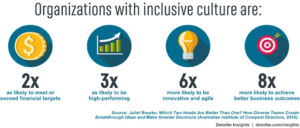
Inclusivity in the workplace has been proven to provide businesses with clear, measurable advantages and successes over less inclusive organizations. Companies are more likely to hit financial goals, generate innovations, be considered high-performing, and experience better business outcomes when diversity is present and embraced through company culture and policy. Creating a gender-diverse environment in the workplace has also demonstrated large-scale economic boosts in many ways, as well, documented in a 2016 report from the United Nations. When plotted against the gender inequality index, data consistently shows the most gender-equal countries are the most developed, have the highest income per capita, are associated with faster economic growth, and experience stronger national competitiveness. Gender diversity and inclusivity are key building blocks to business success and directly impact your business’ bottom line.
Assess your company’s diversity and inclusion levels, and learn how to enhance your current office culture and policies to produce greater business benefits, with this simple checklist from Glassdoor.

Facebook Messenger ditches Discover, demotes chat bots
Chat bots were central to Facebook Messenger’s strategy three years ago. Now they’re being hidden from view in the app along with games and businesses. Facebook Messenger is now removing the Discover tab as it focuses on speed and simplicity instead of broad utility like China’s WeChat.
Source: consent.yahoo.com
At the beginning of this week, Facebook began rolling out a new update of its Messenger app. The update brings a much simpler design to the app, by removing the “Discover” tab and hiding chatbots, along with businesses and games. Users will now only be able to find chatbots by searching for them specifically in the app. Before, you could find business and bots in the Discover tab, but now that is long gone. That also means businesses will no longer be able to promote themselves through Discover and may now be limited to advertising through Stories and other paid marketing channels to promote their company and get users to communicate with their bots.