
Home Grown vs. Professional Video – Each Has a Role to Play in Small Business Marketing
Guest Poster: Peter Stassa of Davideo Company, corporate video production specialists.
You probably don’t have an unlimited budget. We get that, neither do we. We understand that while you value the use of video content to build brand awareness and credibility, you still need to stay within your means. So, ask yourself this:
Where is your content going to be seen?
If you’re posting short videos to consumer-driven social media (Facebook, TikTok, Instagram, etc.) to promote live events or short-term special offers, go right ahead and shoot those yourself. The audience on those platforms is used to seeing a more impromptu, “selfie” style and is less critical of production quality.
But what about the important video content that lives on your website or is being embedded in email campaigns and newsletters? The “about us” videos that explain what your organization does and why you do it? The testimonial stories that are intended to build trust?
You may think: “My phone has a really good camera, I can save money by producing marketing videos in-house instead of hiring an outside company to do it!”
Yes, you can – you can also save money by doing your own dental work with a mirror and a pair of pliers, but it will cost you more in the long run.
For one thing, it takes more than just a good camera. Do you have the other necessary tools and skills to properly record and edit the raw footage so that the end product is worth watching? Do you have the time?
You have to be careful when cutting corners on the production process because home-grown video can backfire on you.
For example, a Brightcove survey of more than 1,200 consumers revealed that the quality of a video has the potential to change the perception viewers have of your brand:
“When consumers are confronted with poor-quality video, they are 62 percent more likely to have a negative perception of the brand that published the video.”
“23 percent of consumers who have been presented with a poor-quality video experience would hesitate to purchase from the brand.”
Sure, the world of B2B and B2C communication has become relatively casual in recent years, and some marketing pundits have been saying that consumers prefer video that is more “spontaneous”, less “flashy”, and thus more “authentic”. But if your camera work is shaky and your image is dark and your audio is hard to hear, your viewer will not stick with it long enough to absorb any of your “authentic” content.
Poor production values are a turn-off. They distract from your message.
Today’s buyers are doing most of their initial research online before they ever get to the point of reaching out for a proposal, which means your odds of getting onto their shortlist depend largely on the quality of the content you post online.
As the saying goes, “you get only one chance to make a first impression” and if the video content on your website, on business-oriented platforms like LinkedIn and Twitter, and in your newsletters and email campaigns looks amateurish, it will pale in comparison with the content offered by your competitors… and you won’t be getting those calls.
Effective and engaging video does not have to look like the opening to the Super Bowl, but sticking to the basic best practices of clean production will allow the viewer to focus on your content. For this reason, you should stay away from a “homegrown” video for critical applications and consider working with a professional when your target audience is made up of your core prospects and potential partners and supporters.

How Chinese Companies Have Responded to Coronavirus
7. Prepare for a faster recovery than you expect.
Source: hbr.org
Well worth the read; here’s a sample:
4. Reallocate labor flexibly to different activities.
For example, in response to a severe decline in revenue, more than 40 restaurants, hotels, and cinema chains optimized their staffing to free up a large share of their workforces. They then shared those employees with Hema, a “new retail” supermarket chain owned by Alibaba, which was in urgent need of labor for delivery services due to the sudden increase in online purchases. O2O players, including Ele, Meituan, and JD’s 7Fresh followed this lead by also borrowing labor from restaurants.
5. Shift your sales channel mix away from face-to-face towards new channels
For example, cosmetics company Lin Qingxuan was forced to close 40% of its stores during the crisis, including all of its locations in Wuhan. However, the company redeployed its 100+ beauty advisors from those stores to become online influencers who leveraged digital tools, such as WeChat, to engage customers virtually and drive online sales. As a result, its sales in Wuhan achieved 200% growth compared to the prior year’s sales.
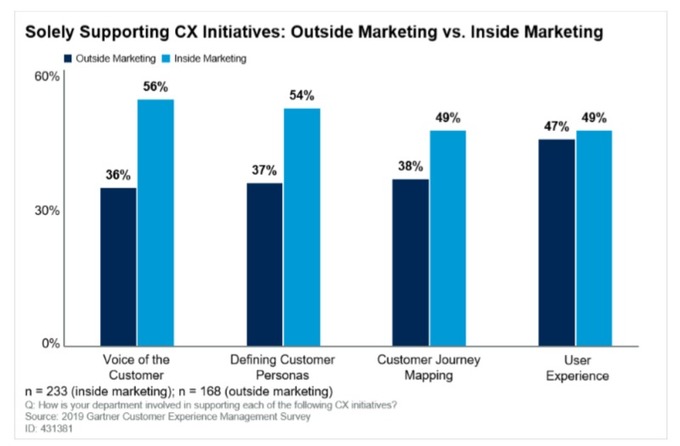
Marketers Are Taking Greater Ownership Over CX Initiatives: Survey
Until as recently as two years ago, customer experience, or CX, tended to fall under the purview of such diverse departments as IT, customer service, and operations but a new survey shows that that responsibility has made a clear shift into marketing departments.
Research company Gartner looked at four specific areas of CX — voice of customer, defining customer personas, customer journey mapping and user experience — and discovered that marketers are now more likely to take ownership in all four areas. In addition, 74% told researchers they expect CX investments to rise either slightly or significantly this year. That increase is evidence that CX initiatives are paying off and delivering measurable value and that companies are better able to connect the dots between positive customer experiences and increased revenue. Have you considered how you can improve your customers’ experience?

Busting the Myths That Keep Your Business From Reaching Millennial Customers
Millennials are often misunderstood from stereotypes that were developed quite a few years ago. They are no longer teens, but ar in their 20s and 30s and make up a large part of the workforce. Even though they’ve been around for a long time now, many businesses still aren’t sure how to reach them. It’s time to bust the myths and get to know the demographic. You may see that what you think is actually the opposite.

Understanding Searches Better Than Ever Before
Google is understanding natural language in searches better than ever before, so well, that it represents “the biggest leap forward in the past five years, and one of the biggest leaps forward in the history of Search …
Particularly for longer, more conversational queries, or searches where prepositions like “for” and “to” matter a lot to the meaning [1 in 10 searches], Search will be able to understand the context of the words in your query. You can search in a way that feels natural for you.”

How to Make Direct Mail Work for Your Business
Many businesses only pay attention to reaching their customers via emails. While email marketing can be a great way to generate engagement and keep customers updated, it’s not the only way. Direct mail offers an option to reach your customers in a more personal way – through their mailbox. And if you think snail mail is outdated, think again: research has found that direct mail typically has a 4.4% return rate, while the rate for email is just 0.12%.
To help make a direct mail campaign successful, it’s important to know who you want to reach and make sure they are actually the ones receiving the mailing. As we know, our physical mailboxes can be as cluttered as our digital ones, but what do most people do when they get their mail? They quickly leaf through each piece and decide whether or not they are going to open it or trash it. Make sure your piece is enticing enough to avoid the recycling bin! An attractive design and a special offer, like exclusive coupons, exciting news or personalization, will make your customers take a second look.
Now that it’s the holiday season, consider using a direct mail campaign to reach your customers in a personal way to wish them a happy holiday season and let them know you’re thinking of them and appreciate their business. Don't forget to include a special offer!

6 Ways To Attract More Clients To Your Business (That You May Have Overlooked)
Of course, the main goal of marketing is to attract more clients to your business, but how can you be sure you’ve covered all your bases to make sure none fall through the cracks? Ask yourself some tough questions, including: have I maximized my online presence? Have I reached out to past clients lately? Am I making use of in-person speaking opportunities? Do I have a content marketing strategy? Does the press know where to find me? Have I maximized my professional networks? If you think you don’t have the time or bandwidth to effectively execute every strategy in the marketing universe, consider asking for help – there are partners out there who can take the weight of management and execution off your shoulders – but make sure you’re employing all relevant strategies to increase your client base.

6 Insanely Effective Tactics to Engage Email Subscribers
Marketing Automation is noted as a top marketing trend for 2019. But how to do it well? There are a few proven tips and tricks to increasing engagement and therefore customers via email marketing. It all comes down to list segmentation, telling the right story at the right time to each individual, and powerful design. While these may seem challenging, when you break each down and have a good plan, it really is achievable.

What Is Personalized Marketing?
Personalized marketing is tailoring your marketing message to an individual. Personalization ranges from personalized video to personalized emails to customized product recommendations and everything in between! With the advancement of technology, customers now expected personalized or customized marketing messages. Read on to learn how to do it right.

Your Marketing Launch Plan Is Missing a Critical Component: Strategy
It seems obvious that developing a clear marketing strategy – one embraced by all internal groups – before deploying a slew of marketing tactics can drastically improve the success of your marketing program. However, many new product marketing launches don’t reach their full potential because of a breakdown in communication and a lack of focus. The most effective path to a successful launch includes identifying clear goals and objectives, and zeroing in on consistent positioning and messaging.