
SEO Doesn’t Stop with a Good Keyword Ranking
Actually, SEO doesn’t even start with a good keyword ranking.
When our clients ask for help in ranking for a specific keyword, or are closely monitoring where they stand (“did you see? we moved up four spots for our company name!”), we invariably stump them when we ask, “and then what?”. Did you check your Analytics after this ranking change to see if new site visitors increased, or if they spent longer on your site, or if they visited more pages? Did you receive more contact us forms, leads, sales? The complete question is not only where you rank, but what actions resulted from those rankings.
Keyword rankings started out as a good indicator of how successful a business could be online. But as more and more people figured out ways to game the system (keyword stuffing, shady linkbuilding and the like), those running the search engines developed ways to combat this. Semantic search, “not provided, ” personalized search, Panda, Penguin and Hummingbird updates… These are just a few of the factors that all but guarantee that you can’t measure the success of an SEO program by tracking where you rank for a specific keyword.
These factors also meant that while many businesses were still focused on traditional SEO tactics, those at the forefront moved on to content marketing – the next quick fix for getting found online. How many times have we read that “content is king” for any online marketing program? Search “quality content” and Google returns about 29, 500, 000 web pages, many of which are eager to provide a formula for producing and promoting good content for your website. Again, we ask, what results do your content marketing efforts produce?
SEO Is Not a Silo Tactic
Sales Renewal believes that SEO cannot be “done” in a stand-alone fashion. Yes, we focus on keywords – each web page or blog post we write has a target keyword. Yes, we focus on on-page factors like title tags and meta descriptions (quite often what is visible in the search results). Yes, we focus on technical factors like speed and broken links. Yes, we focus on off-page factors like relevant links coming from diverse sources linking to different pages on your site.
But if you hire us to “do SEO, ” we’re going to ask a whole lot of questions that at first may not seem relevant to keyword rankings. We’ll ask about your target prospects (your customer personas). We’ll work with you to develop descriptions of your target prospects at the three key stages of the sales funnel (what do they look for when searching for solutions to problems? Comparing vendors? Ready to buy?). We’ll develop your Key Concepts – top-level categories that define your business, including your brand, industry, products and services – and map them to your web pages and target prospects. (Do you have content for visitors at each stage of the sales funnel?) We’ll review your website for appropriate calls to action, depth and quality of content. We’ll review your business presence in online directories and listings sites. We’ll encourage you to produce a company blog and build a reasonable presence on appropriate social media sites.
We ask all these questions because we don’t treat SEO as a silo tactic. Instead, we believe it is an integral part of your overall marketing mix. Managed properly, SEO can help your business by driving relevant traffic to your website and, ultimately, generating leads and sales for your business. Contact us about getting your SEO program started, or find out more about SEO the Sales Renewal way here.
Sales Renewal’s insight:
Actually, SEO doesn’t even start with a good keyword ranking.
When our clients ask for help in ranking for a specific keyword, or are closely monitoring where they stand (“did you see? we moved up four spots for our company name!”), we invariably stump them when we ask, “and then what?”. Did you check your Analytics after this ranking change to see if new site visitors increased, or if they spent longer on your site, or if they visited more pages? Did you receive more contact us forms, leads, sales? The complete question is not only where you rank, but what actions resulted from those rankings.

4 Simple Ways to Test if Your Website is Mobile-Friendly (aka, has a Responsive Design)
As the amount of web browsing done on smartphones and tablets continues to grow, the importance of having your website be mobile-friendly has never been more important. If your website isn’t easily accessible and navigable on mobile devices, you’re missing out on opportunities to connect with and convert potential customers.
It used to be that if you wanted your website to be mobile-friendly, you had to have a separate “mobile site”, often with a different web address than your desktop site. If a customer were to visit www.salesrenewal.com from a smartphone, its web server would detect that, and transparently forward them to m.salesrenewal.com, which would display the same information, but in a format that worked for phones. This approach, however, required considerable management to make sure content was always in sync on the two sites, and even when the content did match up properly, there were potential problems with search engines indexing the same content twice (which can hurt search engine rankings). Further, these mobile sites often were designed primarily for smart phones, so tablet users were still without a pleasant browsing experience.
Fortunately, there is a new technique for handling mobile browsing has arrived, called responsive website design. While it was first proposed in 2004, it wasn’t until 2010 that it was first put into use, and it didn’t become common until 2013. A good definition of responsive website design is (source):
“Responsive design is an approach to web page creation that makes use of flexible layouts, flexible images and cascading style sheet media queries. The goal of responsive design is to build web pages that detect the visitor’s screen size and orientation and change the layout accordingly.”
Put in less tech-y terms, that means that the design of a website will change dynamically based on the amount of space (in particular, the width)available to display a webpage: it still displays the same page elements, just rearranging them based on a set of rules in a style sheet. There can be multiple sets of these rules, so it’s possible to insure the website will look good for all display sizes. Since there’s only one site, there are no issues with content duplication, and the need for ongoing maintenance is greatly reduced.
Testing your website to see if it is mobile-friendly
If you’re wondering, “does my website work on a phone?” here are some easy ways to check if your website was built using responsive website design:
1. Resize your browser window
Since responsive websites change based on the amount of space available to display content, resizing a browser window on a desktop computer will activate the alternate rule sets. For example, on this site, once your browser window is narrower than 960 pixels, it switches from a two-column to a single-column layout. Once it’s narrower than 400 pixels, the navigation menu switches to a much more compact, mobile-friendly menu. If you see these same kinds of changes on your own website, it’s a good bet that your site is already responsive.
2. Browser tools & extensions
There are lots of great tools out there that will let you test different screen sizes to see how your website will display on different devices. One of our favorites is an extension for the Chrome web browser, the Responsive Web Design Tester.
3. Test on a phone
Or, even better, test on every phone you can find! While desktop-based tools can give you a good sense of how the site will display on a mobile device, there’s no substitute for looking at you website on an actual phone. Some interface elements – most notably menus – may work perfectly well when you have a mouse pointer to hover and click, but hitting the exact right spot with a fingertip can be a challenge. The opposite side of that coin is that some elements that work poorly on a desktop may function beautifully on a smartphone.
4. Test on a tablet
While smartphones are important, tablets shouldn’t be neglected in your testing, as their market share has also continued to grow, and while tablets generally have a much larger viewing area than a smartphone, they also have many of the same interface differences from desktop browsers. The best design for tablets often blends features from the desktop and mobile versions of a website.
Is it possible to make an existing website Responsive?
Absolutely and this is done all the time. When the Sales Renewal website was initially launched, for example, responsive website design did not exist, so we had a separate mobile site. As responsive design become more established, we switched over and killed the separate mobile site (saving a bit of $$ every month too). Other sites for which we’ve completed responsive conversions include Concord Flower Shop and Mendon Greenhouse and Florist. If you’re interested in a responsive conversion of your site and other ways we can help turn your website into an effective sales tool, contact us!
Sales Renewal’s insight:
As the amount of web browsing done on smartphones and tablets continues to grow, the importance of having your website be mobile-friendly has never been more important. If your site isn’t easily accessible and navigable on mobile devices, you’re missing out on opportunities to connect with and convert potential customers.
Learn 4 simple techniques to quickly determine if a website is mobile-friendly (aka, has a responsive web design).

How Google Works [Infographic]
From Website Magazine, a very informative infographic (download it).

And it’s amazing to think how much processing is going on in the fraction of a second Google takes before returning your results.
Sales Renewal’s insight:
The first step to improving SEO is understanding. This infographic will help.
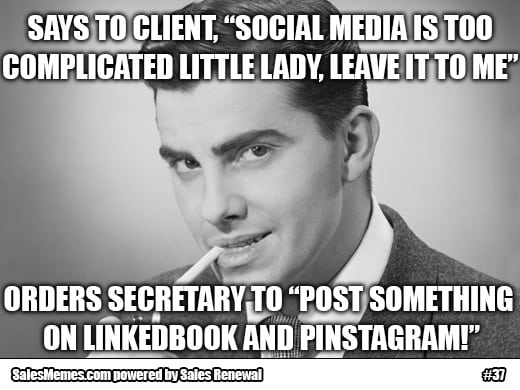
How to Grow, and NOT, Grow Sales: SalesMemes 37 Condescension
Sales Renewal’s insight:
Which do you think he knows less about: social media or women?
The best antidote to the Hanks of the world is knowledge, so here are 3 Ways to Use Pinterest That You Might Not Have Thought Of (part of our Quick Tip Tuesday series).
Visit http://www.SalesMemes.com every Friday to see the latest SalesMemes: the best and worst ideas to increase sales. See more #HucksterHank and his colleagues #SmugMarketerSam, #BadExecutionBob, #GoodExecutionErica and #TrustworthyTom.

Why Use Semantic Markup? Because Making Google Smarter Lets You Stand Out From the Competition
If you’re like most people, the standard markup language of the web-hypertext markup or HTML-is hard enough to learn and master. So the realization that there is a new, powerful kind of markup-semantic markup-gaining traction might make your eyes glaze over. This Growth Spurts blog post, however, will explain what semantic markup is and why you should very much care about, and start using it, now.
When you’re designing an HTML page, you are essentially telling a computer how to present or display your information: how many columns there are on the page, what font size, what words are italicized, and so on. So for example,
$9.99 is an instruction that tells the browser to italicize all the characters between the begin and end tags when it renders the page.
When you are using semantic markup on the other hand, you are telling a computer the meaning, or semantics, of your information, something ultimately much more powerful and valuable than simply how the info should display.
$9.99 is an instruction that tells a search engine like Google that the 5 characters between the begin and end tags should be definitively understood as the price of a specific product.
Without this markup, a search engine will likely use heuristics (i.e., using common formats or conventions to make educated guesses) to try to discern meaning, but this causes difficulty and errors when confronted with uncommon formats and ambiguous situations (e.g., $9, 00).
How is Semantic Markup Used Today?
Once the meaning of information is accurately known, there are nearly unlimited possibilities for how that may be constructively used by search engines. For example, if on Monday you ask Google the following question, it replies with a very appropriate, intelligent answer:

Notice that Google’s answer appears in a large font, right above the natural search results and below the ads-and this prominent placement, which very much draws your eye on the search result page, is completely free (unlike the pay-per-click ads).
The reason why Google can appear to respond so intelligently to this natural language question is because Sales Renewal has put the semantic ‘openingHours’ markup (from schema.org) on the Concord Flower Shop’s About page indicating to Google the meaning of the string of letters “Mo-Fr 9:00-17:30”
Hours:
Monday-Friday: 9:00 – 5:30
More competitive advantage from using semantic markup
Another real world example of the advantage you can gain from semantic markup involves e-commerce.
Another Sales Renewal client, MATsolutions, sells lab refurbished test & measurement equipment online. If you search for Agilent 53181A (a popular device manufactured by Agilent), the MATsolutions listing stands out as the only one that includes the price.
As in many other used markets, price is one of the first things prospects want to know and is an important buying criteria. And MATsolutions is the only firm conveniently supplying this info right on the search result page!

Now you might think you could put the price in the last two descriptive lines in the snippet, but Google builds these lines itself and you really don’t have any control of what Google places there. By semantically marking up the price on MATsolutions.com, you are guaranteed that Google will display price on its own, incremental line … which also results in the client’s snippet being a little bit bigger and a bit more noticeable than the rest.
And in case the above reasons haven’t convinced you of the advantages of semantic markup, a recent research report finds that helping Google understand your pages improves their rank: pages with semantic markup rank four positions better on average, compared to pages without semantic markup!
So do Google and yourself a favor: start using semantic markup to help Google get smarter and your snippets stand out from the crowd.
About the author: Keith Loris is currently the president and CEO of Sales Renewal but before he went over to the dark side of sales and marketing, he had lots of fun researching natural language understanding and neural networks, being awarded U.S. Patents 5, 642, 435, 5, 239, 593 and 4, 876, 731 along the way.
Sales Renewal’s insight:
If you’re like most people, the standard markup language of the web-hypertext markup or HTML-is hard enough to learn and master.
The realization that there is a new kind of markup-semantic markup-gaining traction might make your eyes glaze over.
This Growth Spurts blog post, however, will explain what semantic markup is and why you should very much care about, and start using it, right away.

Client’s Collaboration with Sales Renewal Leads to New Strategies, Brand, Site, Marketing Programs and … a Blue Ribbon
It is generally rare for two different companies, let alone a client and its vendor, to work together so thoroughly, on so many levels, that the resulting whole is greater than the sum of its parts.
However, thanks to Sales Renewal’s revolutionary JointSourcing Solution (a unique hybrid combining elements of joint venturing with elements of outsourcing, in which shared risks and rewards align Sales Renewal’s economic incentives with those of its clients), such synergies are the norm.
If you’ve been wondering how JointSourcing and its three, Blueprint, Build and Sell steps actually works in practice, in the real world, this latest installment of our JointSourcing in Action Case Studies series is for you.
This issue provides a detailed, step-by-step view of how Sales Renewal partnered with our client MATsolutions to overcome their business, marketing and sales challenges to produce a marketing & sales system neither company could have developed as quickly or efficiently on its own. One result of the collaboration: MATsolutions receiving the prestigious Blue Ribbon Small Business of the Year for 2014 award from the U.S. Chamber of Commerce.
As Steve Wedler, VP Sales and Marketing, MATsolutions has said:
“Over the last year with Sales Renewal’s critical assistance, we’ve rebranded the company, launched a new e-commerce site and introduced marketing programs and supporting technologies that truly distinguish MATsolutions from its competitors. Having two highly dedicated and bright teams responsible for this transformation has allowed us to deliver something far superior than either team alone could have. This award is a great acknowledgement of the advances we have made.”
Read the JointSourcing in Action case study.
Sales Renewal’s insight:
If you’ve been wondering how JointSourcing and its three, Blueprint, Build and Sell steps actually works in practice, this latest installment of our JointSourcing in Action Case Studies series is for you.
This issue provides a detailed, step-by-step view of how Sales Renewal partnered with our client MATsolutions to overcome their business, marketing and sales challenges to produce a marketing & sales system neither company could have developed as quickly or efficiently on its own. One result of the collaboration: MATsolutions receiving the prestigious Blue Ribbon Small Business of the Year for 2014 award from the U.S. Chamber of Commerce.

How to Grow, and NOT, Grow Sales: SalesMemes 45 – July 4th Special
Sales Renewal’s insight:
Tastes like freedom?
For some marketing ideas that don’t involve eating endangered species, check out The Red, White and Blue of Marketing Your Business Online
Check http://www.SalesMemes.com every Friday to see the latest SalesMemes: the best and worst ideas to increase sales. See more #BadExecutionBob and his colleagues: #GoodExecutionErica, #SmugMarketerSam, #HucksterHank and #TrustworthyTom.

Quick Tip Tuesday: June Digital Marketing Advice Roundup
Each month we start our Quick Tip Tuesday series with a roundup of useful, hands-on digital marketing advice from experts in their fields. We’ve extracted the most useful information into tips you can use, and we’ve also provided a link to the full articles in case you’d like to learn more.
Looking for more information like this? Check out our Advice from Across the Web page. Here, Sales Renewal selects the best, actionable marketing & technology advice and, importantly, adds our perspective. Think of it as a Marketing Clipping Service for the modern world.
Here, then, are our favorite tips for the month:
1. Why that Video Went Viral – Studies back up instinct: “If you want to melt the Internet, best to traffic in emotion, researchers have found. The emotional response can be happy or sad, but the more intense it is, the more likely the story is to be passed along.” Researchers are beginning to explore the motivations that turn a link, like a video of a firefighter saving a kitten, into click bait. It didn’t work for one site that reported that the kitten eventually died. Read the full story.
2. Measuring the Right KPI – “As marketers have been under more pressure to prove ROI on their efforts, leads have been an easy KPI to measure. Unfortunately, leads don’t always lead to revenue, which is of course the most important KPI for any business.” Read the full story.
3. Grammar Refresher – Affect vs effect. Compliment vs complement. Farther and further. Do you know when to use these words? Here are 30 incorrectly used words that can make you look horrible – and how to use them correctly.
4. SEO and Semantic Search – “SEO and semantic search overlap, but the key to success lies in finding how to mesh them together, so that they complement each other, rather than simply overlapping.” This article gives some insights as to how this is done, including: “Stop trying to just salt your content and meta data with keywords, thinking that’s all you need to get to the top of the search results. And that doesn’t mean to just concentrate on synonyms, either. Instead, focus on conveying the concept of your pages.” Read the full story.
5. Rules for Brainstorming – As we work with our clients on new projects like introducing new programs, rebranding and the like, it’s important to come together as a team. This article from 2009 offers up some good advice for making the brainstorming process work, including:
- defer judgment
- one conversation at a time
- be visual
- stay on topic
Contact us for more on these and other helpful advice.
Sales Renewal’s insight:
Each month we start our Quick Tip Tuesday series with a roundup of useful, hands-on digital marketing advice from experts in their fields. We’ve extracted the most useful information into tips you can use, and we’ve also provided a link to the full articles in case you’d like to learn more.
Looking for more information like this? Check out our Advice from Across the Web page. Here, Sales Renewal selects the best, actionable marketing & technology advice and, importantly, adds our perspective. Think of it as a Marketing Clipping Service for the modern world.
Here, then, are our favorite tips for the month…

Helping Google Understand the “Meaning” of Your Pages Improves Their Rank
A report from SearchMetrics finds pages with Schema.org markup rank an average of four positions higher compared to pages without semantic markup. Read it.
Sales Renewal’s insight:
Giving Google hints to a page’s meaning (semantic markup) is not for the novice but it provides a significant SEO boost.

How to Grow, and NOT, Grow Sales: SalesMemes 41 – How to be a hero for $200
Sales Renewal’s insight:
What’s up next? A Mercedes for $500?
Want to be a hero like Erica? Here’s how she did it: a new cost effective way to attract prospects, customers and partners.
Check http://www.SalesMemes.com every Friday to see the latest SalesMemes: the best and worst ideas to increase sales. See more #GoodExecutionErica and her colleagues: #SmugMarketerSam, #BadExecutionBob, #HucksterHank and #TrustworthyTom.